
Research and Development
History of Research, Development, and Commercialization
Kuraray Chemical Co., Ltd., the predecessor of the Kuraray Environmental Solutions Division, began with the production and sales of carbon disulfide, then launched its activated carbon business in 1965 and gradually shifted its focus to this field.
After discontinuing carbon disulfide production in 1987, the company specialized in activated carbon technologies, the functional activated carbon business, and equipment-related businesses.
In 1997, the Tsurumi R&D building was completed at our plant in Bizen City, Okayama Prefecture, with a total floor area of 1,400 m².
The R&D building is equipped with advanced facilities and conducts practical research closely linked to market needs and manufacturing.


The Potential of Activated Carbon
Activated carbon is a porous carbon material produced from raw materials such as coal and coconut shells. It contains countless microscopic pores measuring 0.1-50 nm in diameter. The internal surface area created by these pores can reach 500 to 2,500 m² per gram.
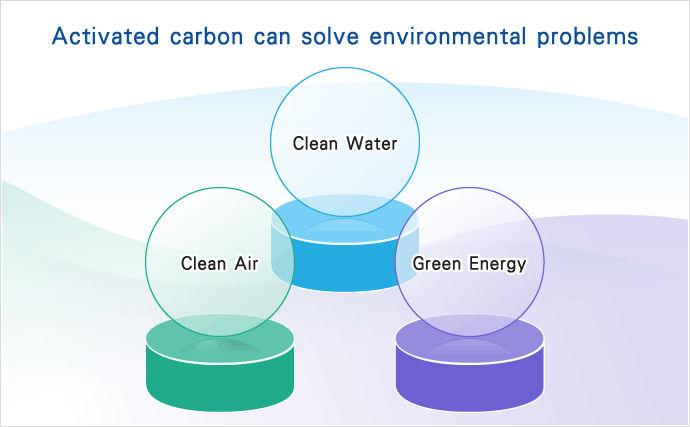
These fine pores enable activated carbon to purify water and air, adsorb and remove chemical substances, recover and recycle valuable compounds, and even store energy.
With increasing environmental regulations and growing public interest, demand for advanced performance has risen to unprecedented levels.
Technology Overview
Since activated carbon is used across many fields, our R&D division leverages a wide range of evaluation instruments to enhance performance and establish fundamental technologies for new product development.
These efforts have resulted in numerous domestic and international patents.
In addition to these foundational technologies, we also collaborate with other R&D teams in Kuraray Group and external institutions to deliver innovative products that meet evolving market needs.
Water Treatment Technologies
- We are developing activated carbon suitable for removing and recovering not only trihalomethanes, musty odor-causing substances, trace amounts of PFAS and other organic compounds, and residual chlorine, but also heavy metals such as lead and metal ions that have traditionally been difficult to eliminate.
- While powdered and granular activated carbon are the most common shapes, we are also developing fiber and filter-type activated carbon. In the water treatment field, a wide variety of application methods are required, and we are advancing molding technologies that leverage the properties of activated carbon to meet these diverse needs.
Air Pollution Control Technologies
- We develop technologies for odor removal, dioxin removal, VOCs recovery, and filters for air purifiers.
- We offer a diversified range of activated carbon shapes including granules, pellets, sheets, and honeycomb shapes. With the growing need for clean air in enclosed spaces, we are also strengthening research and development in this area.
Energy-Related Technologies
- We are enhancing the performance of activated carbon for electric double-layer capacitors with a focus on higher capacity, longer durability, and higher voltage.
- Based on the knowledge gained from capacitor-grade activated carbon development, we are working on new hard carbon materials and promoting their commercialization.
Proposals for Various Applications
Activated Carbon for Automotive
Environmental regulations for automobiles are becoming increasingly strict worldwide. In North America in particular, vapor emission regulations are severe, requiring higher performance of canister systems. This has increased the demand for high-performance activated carbon used in these systems.
Within this regulatory environment, we are developing activated carbon that meets the environmental standards of each region. We are especially focused on developing activated carbon that complies with the North American LEV III regulations. Based on close communication with customers, we adjust the performance characteristics to suit their needs and propose optimal combinations of activated carbon for canister systems.
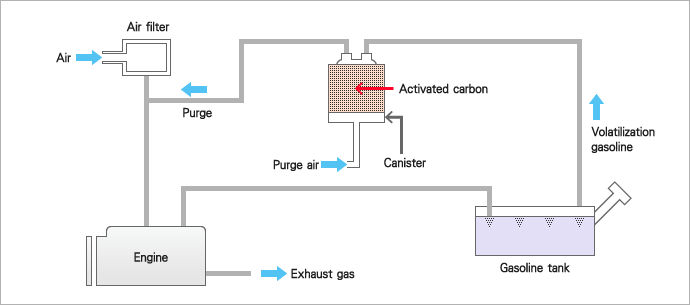
Canister System Conceptual Diagram
Chloramine removal
Chloramine is used as a disinfectant in drinking water. Because it does not form trihalomethanes (which have carcinogenic and teratogenic risks) when reacting with organic matter in the water source and is stable over long periods, its use is increasing in the United States, where distribution systems are extensive.
However, due to its high stability, chloramine is more difficult to decompose and reduce by activated carbon compared with free chlorine. Kuraray provides activated carbon with enhanced catalytic decomposition performance that efficiently decomposes and reduces low concentrations of chloramine remaining in tap water.
Precious Metal Recovery
Traditional precious metal recovery has focused mainly on gold. We have developed technologies that optimize activated carbon for recovering not only gold but also other precious metals efficiently even from liquids containing extremely low concentrations.
Activated Carbon for Electric Double-Layer Capacitors
Electric double-layer capacitors have superior output characteristics and long life compared with general batteries and are used for memory backup, power assist for vehicles and trains, load leveling, rush current absorption, energy regeneration, and as power storage for UPS systems. Kuraray's activated carbon is used as electrode material in a wide range of such applications.
Based on years of accumulated technologies, we continue to enhance the performance of activated carbon for electric double-layer capacitors with a focus on higher capacity, longer durability, higher voltage, and lower resistance.
Flow-Through Capacitors
Activated carbon is widely used for water purification applications in water treatment plants, home water filters, and wastewater treatment facilities. However, ionic substances such as nitrate nitrogen, lead, and fluoride are not easily adsorbed by activated carbon, and removing these ions has long been a challenge. Kuraray has focused on flow-through capacitors as a new approach to ion removal.
Flow-through capacitors are based on the operating principle of electric double-layer capacitors. When electrical energy is supplied to the positive and negative activated carbon electrodes, negative ions are adsorbed on the positive electrode and positive ions on the negative electrode, enabling the removal of ionic substances. Since the desorption of captured ions can also be carried out electrically, the process is safe and avoids the use of chemicals.
Building on our technologies accumulated in water treatment and electric double-layer capacitor applications, we are promoting the commercialization of flow-through capacitors.
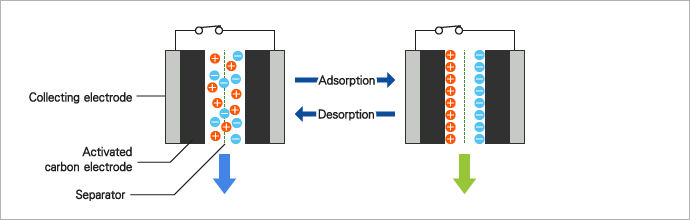
Flow-Through Capacitors

